Ryman Healthcare & Court Theatre
Christchurch projects embody the versatility of engineered wood. By Michael Smith
In profiling a number of recent engineered wood construction builds in New Zealand, Timber Trader News has been struck by the material’s adaptability – and how architects, developers and builders have embraced its advantages and challenges. The projects have ranged from multi-storey secondary and tertiary learning environments to a library/civic centre and a high-quality, carbon zero, repeatable and affordable home.
Our final two reviews for the year, Ryman Healthcare’s Kevin Hickman Retirement Village and the Court Theatre, both in Christchurch, further emphasise wood’s versatility in construction.

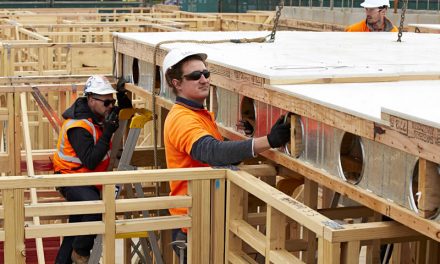
Ryman Healthcare’s three-level apartment block uses two suspended levels of CLT flooring with LVL supporting structure. They sit on a concrete basement and concrete suspended ground floor with CLT corridor and party walls.
As outlined in a Mid-Rise Wood Construction case study, the building was the third of five apartment blocks in the village. In safety terms the mass timber solution resulted in several on-site improvements when compared with the first two blocks (traditional precast concrete structures):
- up to 60% fewer truck movements to the site for deliveries;
- a reduction in heavy lifting requirements from cranes;
- a 45%-55% reduction in hours worked on the timber structure, including faster installation for services like drilling and fixing into timber; and
- less exposure to dust and noise.
Timber reduced the structural weight by over 50% compared with concrete, enabling the construction of lighter foundations and reducing the environmental impact.
CLT and LVL prefabrication improved on-site efficiencies, while the use of advanced acoustic and fire-resistant systems highlighted timber’s ability to meet stringent residential requirements.
Furthermore, the case study noted the significant carbon savings achieved by the mass timber structure – 666,589 kg CO2e as against 2,039,150 kg CO2e for concrete and steel.
Given that memories of the Canterbury earthquakes of 2010 and 2011 were still fresh in the mind – and that the village is home to many senior citizens – Ryman Healthcare committed to a low-damage design. Tectonus seismic connectors and vertical seismic joints allow the building to withstand and recover from a smaller ‘SLS’ (serviceability limit state) event and a larger design-level earthquake.

LESSONS LEARNT
Feedback identified by the case study noted that the project was not without its challenges, and that a number of lessons were learnt which can be applied to similar future builds.
Consistent moisture management and early planning were considered critical, especially for areas exposed during construction. Additionally, coordinating service routes and penetrations to the timber structure proved more complex than anticipated, emphasising the need for upfront planning.
Initial designs, requiring full encapsulation with fire-rated plasterboard, were submitted to Christchurch City Council (CCC) for approval. In the meantime, Ryman discussed the possibility of reducing encapsulation of the timber, working with CCC, Fire and Emergency New Zealand and the design team.
A revised consent was submitted, which effectively removed fire-rated plasterboard encapsulation from most of the CLT walls and all of the ceilings. The design manager commented that councils understand designs for mass timber buildings, but encapsulation and non-encapsulation approaches remain an evolving space.
Given there are only two major suppliers of engineered wood in the New Zealand market, the site, construction and design managers acknowledged the need for more competition and flexibility in sourcing materials – while supply chain challenges emphasised the importance of early engagement with suppliers.

COURT THEATRE
Following the Canterbury earthquakes, Christchurch’s beloved Court Theatre was forced to move from the quake-damaged arts centre to a ‘temporary’ home – an old railway shed in Addington.
Fourteen years later the theatre has returned to the central city in a joint project with the Christchurch City Council – part of a council-envisioned effort to create an arts precinct as the post-earthquake rebuild continues.
 The design was led by Athfield Architects (Christchurch office) and UK theatre specialists Haworth Tompkins. All mass timber components were processed in the North Island by Red Stag TimberLab and installed on-site by Kobe Construction.
A Red Stag TimberLab case study notes that the Court Theatre “is an outstanding example of a hybrid structure, seamlessly integrating steel, concrete and mass timber to optimise structural integrity”.
The mass timber elements include CLT for stair components and mezzanine floors; LVL for structural elements such as roof rafters, columns and trusses; and some externally visible glulam columns.
The project’s early phase saw all parties collaborate closely in a meticulous shop drawing process – ensuring precise 3D modelling to accommodate construction tolerances and material buildability.
A fully co-ordinated and machine-readable model was handed over to Red Stag TimberLab for digital fabrication – with the entire process resulting in minimal waste and successful on-site assembly without the need for modifications.

FEEDBACK
 Webby, architect at Athfield Architects, says the building has been designed to be welcoming to all, while breaking down the traditional barriers between front and back-of-house to make theatre more accessible.
“The timber is drawing attention and intrigue from the public, which we would not get with a comparable steel or concrete structure – and therefore assists in our aim of welcoming people into the theatre.”
Ross Gumbley, the Court Theatre’s Artistic Adviser, says the building represents a new standard in international theatre design and will result in the best possible space to see theatre in New Zealand.
“A theatre can be a difficult building to construct because of the unsupported cavities within it. We have built very few production house theatres in New Zealand, so it has been a real learning curve for the designers and contractors, and they have responded magnificently.
Air New Zealand Hangar 4
A step forward in operational capability. By Michael Smith
Timber Trader News first reported on the plan for Air New Zealand’s Hangar 4 in our March/April 2023 edition; and again in May/June 2024 as Hangar 4 began to take shape. The renders provided an impressive visual preview, but there’s nothing like the real thing as depicted in the stunning images that follow.
Air New Zealand recently unveiled Hangar 4, a state-of-the-art aircraft maintenance facility that represents one of the airline’s most significant infrastructure investments.
Forming part of the airline’s Auckland maintenance base in Māngere, Hangar 4 marks a bold step forward in operational capability and long-term growth strategy. Designed to serve the next 50 years of aviation, the new facility positions Air New Zealand at the forefront of modern fleet maintenance as it prepares for the arrival of next-generation aircraft.
At 10,000 square metres, 35 metres high and 98 metres wide, Hangar 4’s scale allows Air New Zealand engineers to service a Boeing 787-9 Dreamliner and two Airbus A320/A321s simultaneously, supported by an additional 5,000 square metres of specialist workshops and engineering spaces. Cutting a striking figure on the South Auckland skyline, the hangar has already become a landmark of note for arriving travellers.
Air New Zealand Chief Executive Officer Greg Foran said the opening of Hangar 4 was a proud moment for the airline.
“This is a state-of-the-art facility that will enable us to maintain our fleet to the highest standards of safety and performance, while giving us the flexibility to adapt as aircraft technology evolves.
“This investment ensures we have fit for purpose, modern infrastructure for our engineers to service our fleet. The investment also signals our confidence in our future – in our people, our country, and in the proud role we play in connecting New Zealanders to each other and New Zealand to the world.”
An official opening event was attended by Prime Minister Christopher Luxon, who was chief executive officer of Air New Zealand when Hangar 4 was first announced in 2019.

INNOVATION & SUSTAINABILITY
Hangar 4, which is targeting a 6 Green Star Rating from the New Zealand Green Building Council, is the largest single-span timber arch aircraft hangar in the southern hemisphere.
Timber was chosen for its lighter weight, ability to be sourced sustainably – from plantations in Nelson and Wodonga – and for its performance in a coastal environment.
An ETFE roof delivers natural light and retains heat without the need for a heating system, aided by ceiling fans that circulate warm air in winter and provide cooling in summer.
Prefabricated trusses, each weighing 38 tonnes, were built in 25-metre sections, assembled onsite and lifted into place using New Zealand’s largest crawler crane – a unique construction method at this scale.
Underground service pits eliminate the need for surface cabling, offering both flexibility and efficiency for maintenance teams. The structure also connects with the adjacent Hangar 3 via shared workshops and tool stores, boosting efficiency across maintenance programmes.

PROJECT DETAILS:
Embodied carbon: awaiting results of the Life Cycle Assessment (LCA) report, which will provide a comparison of embodied carbon for the timber structure versus a conventional steel alternative.
Hangar doors: tallest point approximately 26 metres above ground level; overall width approximately 80 metres. Primarily engineered timber, while the final two trusses and end wall are steel which provides additional strength and rigidity required to support the doors and their operating systems.
Flex: the hangar’s timber structure is designed to meet New Zealand’s seismic standards. Timber has an inherent ability to flex under load, and the structural system is detailed to accommodate earthquake movements safely.
Trusses: each 25-metre glulam truss section was spliced on-site. The splice connections were screw-fixed, with around 4,000 screws used at each joint. High- powered battery impact drivers were used to drive the 200 mm structural screws into place. This ensured strong, durable and precise connections between the truss sections.
Hangar roof: clad with ETFE (ethylene tetrafluoroethylene), a lightweight fluoropolymer membrane. ETFE does not corrode and has excellent resistance to UV light and environmental pollutants. It is installed as multi-layer cushions that are welded at the edges and fixed into a high- quality aluminium frame system. The cushions are pneumatically stabilised by a low-pressure air system of approximately 220 Pa. This pressure is sufficient to keep the cushions inflated and stable under wind and load conditions.