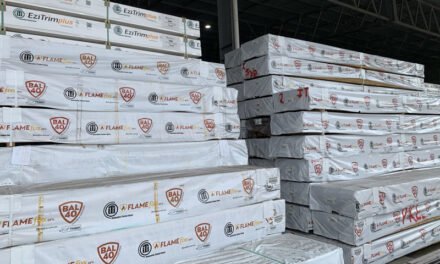
New CLT and GLT battery charging facility at Timberlink Australia’s Tarpeena site. By Campbell McInnes
Across Australia’s industrial sector, the transition to electric-powered equipment is steadily reshaping the way facilities are designed, operated and future-proofed.
Forklifts, loaders, and mobile plant that once relied heavily on diesel or LPG are increasingly being replaced with electric alternatives as businesses pursue safer, cleaner, and more efficient operations.
But while much attention is given to the vehicles themselves, the infrastructure supporting that transition is often overlooked.
At Timberlink® Australia’s Tarpeena operation in South Australia’s Green Triangle, a new purpose-built battery charging facility is demonstrating how industrial infrastructure can evolve alongside operational change, while also showcasing the expanding role of engineered timber in demanding industrial environments.
Currently under construction ahead of the arrival of a new electric forklift fleet in 2026, the project is far more than a simple utility building. It represents a convergence of operational planning, safety engineering, sustainability, and Australian mass timber manufacturing capability.
Constructed using NeXTimber® Cross Laminated Timber (CLT) and Glue Laminated Timber (GLT), the facility provides a practical demonstration of how engineered timber products can perform in highly functional industrial settings where durability, efficiency and risk management are non-negotiable.
In many ways, the project captures a broader shift occurring within Australia’s timber and manufacturing sectors, one where innovation is increasingly being driven by operational necessity as much as architectural ambition.

BUILDING FOR A CHANGING INDUSTRIAL LANDSCAPE
For industrial operators transitioning to electric mobile plant, charging infrastructure introduces an entirely new layer of operational complexity.
Battery charging areas require carefully managed ventilation, controlled access, dedicated servicing zones and clear separation from broader site traffic movements. Without centralised planning, charging systems can quickly become fragmented across a site, creating inefficiencies, and increasing interaction between pedestrians, forklifts, and heavy equipment.
At Tarpeena, Timberlink recognised early that electrification would require more than simply installing charging stations. The solution needed to integrate seamlessly with existing workflows while supporting sate and efficient site movement.
The new building has been developed through a detailed HAZOP (Hazard and
Operability) process, with extensive consideration given to forklift movement, traffic separation, charging procedures and site integration. The final location was selected through site-wide mobile plant network planning to ensure the building could operate safely within existing workflows while minimising disruption to production activity.
This planning aligns with Timberlink’s broader FY25 decarbonisation strategy, which prioritises electrification of mobile plant as a key lever in reducing operational emissions. In March 2025, the company ordered 20 electric 7-tonne forklifts to replace diesel units across its Bell Bay and Tarpeena operations. These units are expected to deliver a significant share of the company’s Scope 1 and 2 emissions reduction pathways to FY2030, with each forklift avoiding approximately 38 tonnes of CO₂-e annually compared to diesel equivalents.
The new charging facility has therefore been designed not in isolation, but as part of a system-wide transition to electrified site logistics.
Its placement within the site has been carefully aligned with existing mobile plant routes and servicing access, ensuring the building supports daily operations without disrupting production activity elsewhere on site.
TAKING MASS TIMBER BEYONG COMMERCIAL BUILDINGS
Mass timber has gained significant momentum in Australia over the past decade, particularly within commercial offices, schools, public buildings, and mid- rise residential developments. Yet despite growing familiarity with CLT and GLT construction, industrial applications have remained comparatively rare.
The Tarpeena project challenges that perception.
Rather than using timber purely as a design feature or sustainability statement, the facility applies engineered timber in a highly practical setting, one where the structure must withstand the realities of an active industrial environment every day.
The decision to use NeXTimber products was not simply aesthetic. It reflected confidence in the structural capability, precision manufacturing and long-term performance of modern engineered timber systems.
Manufactured at Timberlink’s NeXTimber facility at Tarpeena, the CLT and GLT products used in the project are produced from Australian plantation-grown radiata pine, transforming locally sourced timber into large-format structural components through advanced manufacturing processes.
This creates a compelling closed-loop narrative: plantation timber grown in the Green Triangle is processed, manufactured and then re-deployed within the same regional industrial ecosystem.
For the company, the project provides an opportunity to demonstrate the versatility of mass timber in an operational environment that resonates strongly with industrial clients, engineers, and contractors.
It is one thing to showcase engineered timber in a premium office lobby. It is another to use it in a hard-working industrial facility designed around mobile plant operations, charging systems and safety-critical infrastructure.
That distinction significantly broadens the conversation around where timber belongs within the built environment.

WHY CLT AND GLT WERE WELL SUITED TO THE PROJECT
The use of both CLT and GLT within the facility highlights the flexibility of engineered timber systems when applied to industrial construction. GLT delivers high structural strength and long-span capability, making it well suited to beams and primary structural frames. CLT panels provide rigid wall and roof systems manufactured with high precision and rapid installation capability.
The prefabricated nature of mass timber also provides advantages during construction.
CLT and GLT components can be digitally manufactured off-site using CNC technology before arriving ready for installation, improving accuracy, and reducing on-site construction time. Timberlink’s Tarpeena facility is capable of producing CLT panels up to 16 metres long and 3.5 metres wide, enabling significant design flexibility for industrial and commercial applications.
This prefabrication advantage is particularly important in live industrial environments where downtime and disruption must be minimised.
Across FY25, Timberlink has continued to expand its engineered wood capability through its NeXTimber facility, strengthening domestic supply chains for CLT and GLT and improving delivery certainty for Australian construction markets.
For specifiers and builders, this local manufacturing base provides three key advantages:
- Reduced lead times compared to imported systems,
- Greater collaboration between design, engineering, and manufacturing teams,
- Improved supply chain resilience for large-scale projects.
In effect, the Tarpeena facility represents a vertically integrated timber system, from plantation forestry through to finished structural application.

ELECTRIFICATION AND CARBON REDUCTION IN PRACTICE
The transition to electric forklifts is expected to:
- Reduce Scope 1 emissions from diesel combustion,
- Improve local air, by reducing pollution,
- Enhance operational safety through AI-enabled detection systems,
- Support long-term decarbonisation targets aligned with SBTi pathways.
This aligns with Timberlink’s broader Science Based Targets, including:
- 50.7% absolute reduction in Scope 1 & 2 emissions by FY2030 (vs FY2018),
- 25% absolute reduction in Scope 3 emissions by FY2030 (vs FY2022),
- Dedicated FLAG target covering land-based emissions.
The charging facility at Tarpeena is therefore not just infrastructure, it is an enabler of measurable carbon reduction.
SUSTAINABILITY THROUGH BOTH OPERATIONS AND MATERIALS
The move toward electric forklifts forms part of a wider industry shift to reduce operational emissions. However, what makes the Tarpeena project particularly notable is that sustainability has been addressed at two levels:
- Operational decarbonisation through electrified mobile plant
- Embodied carbon reduction through mass timber construction
By using CLT and GLT as the primary structural materials, the charging facility reduces reliance on carbon-intensive steel and concrete while also storing carbon within the building structure itself.
This dual approach reflects a growing trend in industrial design, where sustainability is no longer an add-on but embedded across both infrastructure and operations.
Importantly, the timber used in this project is sourced from sustainably managed plantation forests, reinforcing the role of Australian forestry as a renewable resource base supporting lower-carbon construction outcomes.
 DEMONSTRATING CONFIDENCE IN AUSTRALIAN MANUFACTURING
There is also a strong symbolic element to the project. Timberlink is not simply supplying engineered timber products into the market, it is actively deploying them within its own operational infrastructure.
That decision sends a clear signal to the broader construction and industrial sectors: locally manufactured CLT and GLT systems are capable of meeting real-world industrial demands.
In an industry where specification confidence is often driven by precedent, the Tarpeena facility provides exactly that; a working example of mass timber performing in a live industrial environment.
It also reinforces the maturation of Australia’s engineered timber sector, which is increasingly capable of supporting complex, large-scale infrastructure applications.
A GLIMPSE INTO THE FUTURE OF INDUSTRIAL CONSTRUCTION
As industrial facilities continue adapting to electrification, automation, and sustainability pressures, supporting infrastructure will need to evolve in parallel.
The Tarpeena battery charging facility suggests that engineered timber is well positioned to play a much larger role in that future.
It demonstrates that mass timber can move beyond commercial and residential typologies into environments where operational performance, durability and safety dominate design requirements.
More importantly, it shows that Australia’s timber manufacturing sector is no longer defined solely by traditional framing products or export commodities. It is increasingly a provider of advanced, engineered solutions for complex industrial systems.
At Tarpeena, the transition to electric operations is helping power another shift as well, as a broader rethinking of what industrial buildings can be made from, and what Australian timber manufacturing can deliver.
In that sense, the charging facility is not just supporting the future of electric forklifts. It is quietly demonstrating what the future of industrial construction could be.
For more information visit www.timberlinkaustralia.com.au. Registered trademarks include Timberlink® and NeXTimber®.