 Why after sales support is the real measure of performance in timber handling. By Campbell McInnes
When we last sat down with Bruce Peatman, Managing Director of Hubtex Australia, we reflected on a remarkable 30-year journey. From modest beginnings in Riverstone to becoming a nationally recognised specialist in multidirectional and long-load handling solutions, Hubtex Australia’s story has been one of steady growth, technical innovation and enduring partnerships between the German factory and the Australian team.
But while machinery often takes centre stage, this conversation focused on something equally, if not more, important: service and after sales support.
In a sector as demanding as timber and engineered wood products, the true test of a supplier is not simply the machine they deliver, but the support they provide long after that machine is commissioned.
As Bruce puts it plainly:
“I have always maintained that our biggest point of difference is our after-sales support. It is the way we treat and communicate with our customers. While our aim is to get it right every time, if something does not go according to plan, then we communicate, work with the customer, and ensure the customer is happy with the outcome. We set ourselves a very high bar and do everything possible to reach it.”
A SPECIALIST IN LONG-LOAD HANDLING
For nearly 31 years, Hubtex Australia has supplied specialised multidirectional equipment into the Australian market, representing globally respected European manufacturers including HUBTEX Maschinenbau GmbH & Co. KG and Bulmor Industries GmbH.
Over that time, the timber sector has developed and changed dramatically.
“Because Hubtex Australia has been selling into the Australian market for more than 30 years, we have seen a lot of changes,” Bruce explains. “Areas like moving product from outside to indoors, storing products higher and in more recent years the length of products available, particularly with the introduction of Engineered Wood Products have all been changes that our machines have had to adjust and adapt to.”
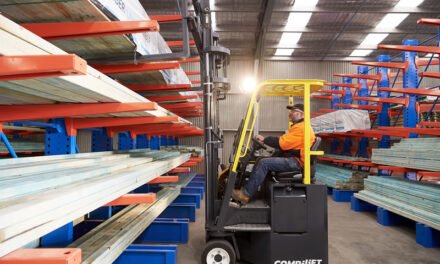
The growth of Engineered Wood Products (EWP) has been particularly significant. Lengths of 16 metres and beyond are now common, demanding larger spreaders and, in some cases, 10-metre fork carriages to safely support and transport loads. 
As warehouses moved indoors to protect stock quality, racking heights increased. Where once five or six metres was typical, today 10 metres, and even higher, is increasingly common where building design permits.
And yet, even as storage moves indoors, truck loading often remains outdoors. “We have started to see a bit of a swing back to rubber tyres for this reason,” Bruce notes.
Through it all, Hubtex has maintained a deliberate focus: multidirectional and narrow aisle equipment. Rather than offering a broad portfolio of conventional forklifts, the company has concentrated on doing one thing exceptionally well.
THE NEW FLUX 45: A 2-IN-1 SOLUTION FOR MODERN TIMBER OPERATIONS
Pictured on the front cover of this issue is the HUBTEX FLUX 45 electric multidirectional forklift, a machine that encapsulates the evolution of timber handling discussed throughout this feature.
Building on the proven FLUX 30 platform, the FLUX 45 increases capacity to 4.5 tonnes (also available in a 4.0-tonne configuration) while maintaining a compact footprint and exceptional manoeuvrability. Designed as a genuine 2-in-1 solution, it combines the characteristics of a traditional counterbalance forklift with the versatility of a sideloader in one highly adaptable truck.
Bruce Peatman explains its practical appeal, “The FLUX 45 is a three-wheel drive, highly capable indoor-outdoor machine with a counterbalance, which makes it a perfect choice for loading and unloading timber on and off trucks.”
That balance of stability and agility is central to its design. Equipped with HUBTEX’s HX 360° continuous steering system, the FLUX 45 can change seamlessly between longitudinal and transverse travel without stopping. For timber operations where product is picked inside, staged under cover outdoors, and then loaded for dispatch, this flexibility reduces handling time, minimises tyre wear and improves overall efficiency.
Large tyres, generous ground clearance and all-wheel drive capability make it particularly suited to yard aprons and mixed- surface environments. At the same time, its compact mast design, hydraulic sideshift fork carriage and mast tilt function optimise load visibility and control, essential as racking heights increase, and engineered wood products continue to grow in length.
Inside the cabin, ergonomic design supports operator performance over long shifts, with a central seating position, intuitive controls, and a clear colour display interface. In many ways, the FLUX 45 represents more than just lifting capacity; it reflects a deliberate focus on combining engineering precision with real-world practicality.
THE TIMBER INDUSTRY’S EVOLVING DEMANDS: FROM BULK PACKS TO JUST-IN-TIME PICKING
Timber wholesalers and processors today face a very different market compared to 20 years ago.
“Over time, wholesale and timber supply seems to have changed from primarily supplying large volumes and packs of timber, whereas today, buyers are looking for smaller just-in-time volumes,” Bruce says. “There has been more of a requirement with picking smaller than pack quantities.”
This shift has profound implications for materials handling:
- More frequent picking
- Increased traffic in aisles
- Greater reliance on racking systems
- Higher expectations for accuracy and efficiency
There is no “one-size-fits-all” solution, as every business is unique.
Each site has its own constraints: building width, rack height, yard layout, product length, type of products and truck access. That is why Hubtex Australia places strong emphasis on site inspections and tailored recommendations rather than off-the-shelf answers.

REDUCING DAMAGE, IMPROVING QUALITY
Historically, one of the biggest concerns raised by timber companies was product damage and downgrading.
“Moving away from storing timber outside, to undercover certainly improved the quality,” Bruce says. “In addition, changing from the traditional forklift to a multidirectional sideloader further reduced the amount of damage that was occurring in the timber handling process.”
Why? The reason is simple: load stability.
Instead of carrying long packs across the tines and swinging wide around stacks, multidirectional sideloaders carry product lengthways on a wide carriage. The load remains properly supported and balanced.
“Timber is generally a bulky type of product,” Bruce explains. “If you have to make large swings with the timber, there is a higher chance of the product falling or running into something.”
Loading trucks becomes safer too. With a multidirectional truck, the operator can approach the vehicle sideways, or straight on, without swinging the load into position.
 SAFETY AS A SERVICE COMMITMENT
Modern timber yards present numerous blind spots and pedestrian interactions. Hubtex has embraced technology to enhance safety.
Blue spot lighting is now standard on most of the newer Hubtex models.
Bruce advised, “the way the blue spot works, is from the pedestrian’s perspective. If you are approaching the end of an aisle and you see the blue light, you know there is a fork truck coming and you know to stop and look. The blue beam of light is generally set to show up at three to five metres ahead of the truck, in the direction of travel.”
While highly effective indoors, blue spot lighting is less visible outdoors. That has led to growing interest in AI-enabled pedestrian alert camera systems.
“These AI video cameras will detect very accurately humans, including body parts,” Bruce says. “If there is only part of a person visible, for example like a leg or hand, the system will detect it. The monitor in the cabin puts a red box around the person and an alarm sounds to notify the operator.”
This integration of safety technology reflects a broader philosophy: service is not just reactive. It is proactive, preventative, and consultative.
SERVICE EXCELLENCE: THE BACKBONE OF PERFORMANCE, COMPLEXITY DEMANDS EXPERTISE
Multidirectional equipment is inherently more complex than conventional forklifts.
“With the conventional forklift you are only travelling in two directions,” Bruce explains. “Our HX steering means that our multidirectional machines can change direction while still in motion. By not having to come to a complete standstill, it saves a lot of energy and tyre wear.”
However, advanced steering, electronics, and calibration demand specialist knowledge.
“These machines need to be calibrated properly,” Bruce says. “Once the machine is calibrated correctly, the machines work well.”
He also notes that, in many ways, modern machines are simpler than those of 30 years ago. “There were a lot more sensors with relays, wires and switches. Now electronics have simplified the older technology, with minimal wear-and-tear items.”
Katharina Beuel, Sales & Marketing Administrator, highlights another crucial difference. “With conventional forklifts, there will often be multiple forklifts on one site. However, with multidirectional forklifts, as they are so versatile, there may only be a need for one or two forklifts on a site. So, servicing and downtime becomes more critical.”
In other words, when a specialist machine stops, the operation can grind to a halt.
FIRST-TIME FIX: MORE THAN A CATCHPHRASE 
Hubtex Australia emphasises an industry- leading first-time fix rate.
“As the phrase suggests, we look to fix a machine on the first visit of any call-out,” Bruce says. “This comes about because of the level of spare parts we carry, the training and knowledge of the technicians we have, along with the back-up support provided from Germany as well.”
This is where service and spare parts intersect. Without stock on hand, even the most skilled technician is limited.
TRAINING: INVESTING IN CAPABILITY, FROM GERMANY TO THE WORKSHOP FLOOR
Higher-level technicians are selected to visit the German headquarters for further training.
“They undergo further training and absorb information,” Bruce explains. “Those staff then bring back the additional understanding and skills learnt and are able to pollinate other technicians here in Australia.”
Training takes multiple forms:
- Factory training in Germany
- One-on-one field mentoring
- Annual classroom sessions with visiting factory trainers
- Updates on new technologies and software improvements
There are also machines in the market that are 10, 15 or even 20 years old. Software updates can sometimes optimise performance on these older units, extending service life and enhancing reliability.
The investment is significant, particularly given the distance between Australia and Germany. But Bruce sees it as essential.
“It is easier talking to someone in another factory in another country when you have met them and spent time with them before.”
AFTER THE SALE: WHERE THE REAL WORK BEGINS
Hubtex Australia’s after sales pathway is structured and deliberate:
- Delivery of the machine
- Operator induction and training
- Documentation of any concerns
- Discussion of general maintenance
- Sales follow-up one to two weeks later
- Complimentary 50-hour first service
“Our sales and service teams are integrated. When a machine is first delivered both the salesperson and a technician will attend. They both have different skill sets and perspectives.” Bruce explained.
At 50 hours, the first service is conducted free of charge, offering the perfect opportunity for adjustments, but also any follow up questions.
“We do not just sell someone a fork truck and leave it with them,” Bruce says.

TWO-HOUR METROPOLITAN RESPONSE
Understanding the critical role these machines play, Hubtex Australia has set a benchmark of responding to breakdowns in metropolitan areas within two hours.
“These jobs are considered high priority,” Bruce says. “We treat them as such.”
In a timber operation where dispatch deadlines are tight, this responsiveness can mean the difference between meeting and missing delivery commitments, which is critical for just-in-time deliveries.
SUPPORTING REGIONAL AND REMOTE AUSTRALIA
With branches in Riverstone (NSW), Hallam (VIC), Meadowbrook (QLD), Pooraka (SA) and Jandakot (WA), Hubtex Australia maintains national reach. Yet much of Australia’s timber industry operates beyond metropolitan centres.
Bruce explains their collaborative approach: “What we have found works exceptionally well is we may have a timber customer out at Cowra, in regional NSW, for example. We ask who they currently use and are happy with for their services. If there is already a relationship, we will work with that service company, give them support, let them know we have parts available, and that we are only a phone call away.”
Hubtex provides technical assistance 24/7 and involves local service providers during installation, showing them the machine “in its raw state” and ensuring they are familiar with components and spare parts systems.
“Some organisations can be quite closed and protective about their IP, service codes and technical information,” Bruce says. “We tend to be very open with that. It benefits the customer.”
This openness reduces reactive emergencies and strengthens regional capability.
 PREVENTATIVE MAINTENANCE: PROTECTING UPTIME
Hubtex service intervals are generally set at 500 hours, typically around three months, adjusted to suit usage.
Like any motor or machine, if there is regular and ongoing maintenance, there is less likelihood of a breakdown. Emergency breakdowns are treated as top priority and often provide opportunities for broader discussion.
“Often these breakdowns are caused by an operator hitting something,” Bruce says. “Our guys are very good at communicating. They may have come across the same issue previously and can explain what others have put in place to prevent ongoing issues.”
SPARE PARTS: SPEED, AVAILABILITY AND ASSURANCE
If service is the backbone, spare parts are the bloodstream.
“This part of our business is critical,” Bruce says.
Hubtex machines are engineered with high-quality components and significant commonality across models. An electronic control unit or wheel may fit multiple machines, simplifying inventory management.
However, Australia’s distance from Europe makes local stockholding essential.
“We are a long way away from the factory,” Bruce explains. “If we need to get a part airfreighted, it can still be close to one week, before we see the part. Therefore, we need to make sure we have the parts here in Australia.”
Mission-critical components are stocked centrally in Sydney, with healthy inventory levels in other states too.
If an electronic control fails, the whole machine stops. “Even if it only fails once in a blue moon, we carry those items. We can program for the specific machine and send them directly to site, generally overnight.” Bruce explained.
Hubtex maintains strong relationships with major freight and courier providers, including next-flight options. In urgent cases, staff will personally deliver parts to the airport to ensure speedy dispatch.
Service vehicles themselves are strategically stocked.
“Our technicians try to anticipate what may be required for any service or call-out,” Bruce says. “It varies from state to state depending on the mix of machines.”
PEOPLE MAKE THE DIFFERENCE
Bruce is unequivocal: “Our people really do make the difference.”
Hubtex Australia has remarkably low staff turnover. Many team members have been with the company for 10, 15 or 20-plus years.
Katharina adds, “The first two apprentices Hubtex Australia ever had been still working here and have been with the company for more than 20 years.”
Apprenticeships cover mechanics, spray painting and spare parts. Currently there are four apprentices in Sydney, two in Brisbane and one in Melbourne.
Bruce values generational diversity.
“The younger ones bring new ideas, and the older experienced staff have ‘been there and done that’ and bring a wealth of knowledge to the table.”
He shares a simple but telling anecdote about their first apprentice, Michael, known universally as “Stick”.
“When visiting sites around NSW, customers will often ask me, ‘How is Stick going?’ That is the reality of having staff who have been with the company for decades. Relationships are built and that matters.”
Long tenure translates into accumulated knowledge, of machines, of customers and of recurring challenges. That knowledge cannot be taught in two or three years.
 ELECTRIC MACHINES AND TOTAL COST OF OWNERSHIP
Electric multidirectional forklifts are gaining momentum in Australia.
“In general, electric machines have less maintenance than diesel or gas machines, which equates to less downtime,” Bruce explains.
As more timber yards operate indoors, eliminating exhaust fumes is a significant advantage.
Bruce observes a broader shift in customer thinking:
“Customers are becoming more aware of looking at the total cost of ownership, as opposed to historically, where people would look more at the total cost of initial capital outlay.”
Lithium-Ion battery technology further enhances appeal, offering:
- Zero battery maintenance,
- Opportunity charging during breaks,
- No need for full discharge cycles,
- Built-in fire suppression and monitoring systems.
Insurance concerns occasionally arise due to misconceptions around battery fires; however, Bruce is clear.
“The chemistry is the safest available, and the batteries and chargers have electronic controllers monitoring speed of charge and temperature. If they start to get hot, the system shuts down. It is the safest package available.”
A PARTNERSHIP APPROACH
As Hubtex Australia approaches three decades representing Bulmor in Australia, and continues to strengthen ties with Germany, the consistent theme remains partnership.
Whether working with metropolitan timber merchants or wholesalers, remote sawmills, frame and truss plants or regional service providers, the philosophy is the same: transparency, communication, and support.
“Communication is one of Hubtex Australia’s strengths,” Bruce says. “Even if there is bad news to share, it is better to raise any concerns, address them, find solutions and work together.”
RAISING THE BAR
In the timber industry, machinery is mission critical. Long loads, narrow aisles, tight dispatch windows and rising warehouse costs leave little room for downtime.
Yet the true differentiator is not just the engineering of the machine. It is the engineering of the support system behind it:
- Highly trained technicians
- Integrated sales and service teams
- Proactive preventative maintenance
- Comprehensive spare parts inventory
- Empowered branch managers
- Long-serving staff who know their customers.
Bruce summarises it simply:
“We set ourselves a very high bar and do everything possible to reach it.”
From two-hour metropolitan response times to regional collaboration, from mission- critical spare parts stockholding to factory- trained technicians, from apprenticeships to AI safety systems, the commitment is clear.
In the Australian timber industry, machines may move the load.
But service keeps the industry moving.
For more information call 1300 365 621, email info@hubtex.com.au or visit Hubtex Australia at www.hubtex.com.au